Thursday, April 10, 2014

Marcella's Elevate Experience

My first experience at the Central States Communication Association conference, Elevate, was certainly one to be remembered. I attended a G.I.F.T. (Great ideas for teaching) session, 4 panel sessions, and presented a G.I.F.T. with my classmates. I hope to return to another conference in the future as a presenter or just an attendant. This conference is a great way to network, learn, and change the way that you may think about different things.

Drew, Me, & Lexi
On Friday, the first day of the conference, we thought that it would be beneficial for us to attend a G.I.F.T. session because on Saturday we would be presenting our own G.I.F.T., and we thought it would be good to kind of know how the sessions go.  I was very pleasantly surprised by the way the session was set up.  It was a little bit different than I imagined, but it works well for the session.  Basically, in a G.I.F.T. session there are up to ten groups or individuals presenting G.I.F.T.s.  Each group is assigned a table that has six or seven chairs around it for session attenders to sit at, and the attenders have a list in their program of the different G.I.F.T.s that are available to attend at a given session.  The session that we attended was at 11:00 in the morning, and I had the opportunity to hear about five different G.I.F.T.s.  The G.I.F.T.s that I heard were called: Elevating Speech Evaluations through Twitter, Analyzing Target Audience, The Cups Game as Small Group Communication Activity, “Elevating” Students’ Understanding of Communicator Style: How Would Each Communication Style Manage Organizational Conflict?, and Talk Story: Developing Thematic Narratives.  One thing that I noticed at the G.I.F.T. session is that there were no other undergrads presenting G.I.F.T.s.  All of the presenters were grad students or professors.

After the G.I.F.T. session we took a break for lunch, then at 2:00 in the afternoon the three of us chose panels that interested us and attended them.  Drew and I ended up picking the same one: “All Immigrants are Artists”: The Artful Negotiations of Diverse Immigrant Experiences.  During this panel we heard five individuals speak about their experiences as immigrants or as children of immigrants.  The first speaker was Alberto Gonzalez from Bowling Green State University.  He spoke about his work at the non-profit organization called La Conexion.  This is a place that Latinas in Bowling Green, Ohio can go to feel connected to their culture as well as the community they live in.  Gonzalez discussed the issues that La Conexion is facing as it becomes more public and well known because of immigration laws.  Immigrants may come to La Conexion and not have the legal papers to be in the United States.  The second speaker was named Eddah Mutua.  Eddah is from Kenya, Africa.  She spoke about a non-profit that she is involved in called Prairie Garden.  Prairie Garden is a garden that refugee women from Africa work together on.  The garden is in St. Cloud, Minnesota which is also where Eddah teaches.  Prairie Garden allows the women refugees to speak their own languages, grow their own food, and interact with other immigrants.  Eddah described the Prairie Garden as a place where the women can be free to be themselves in their new country.  The third speaker on the panel was Ahmet Atay.  Ahmet Atay spoke about a film director from Italian and Turkey descent who is also queer.  He spoke about how this director is changing the film community with his films.  The fourth panelist was Sunny Lie.  Sunny Lie is a Chinese Indonesian, and she works closely with Chinese Indonesian students who are pursuing higher education in New York City.  She spoke about how even though they try to hang on to their culture and not assimilate to American culture, they show signs of assimilation. The last panelist to speak was David Hanley-Tejeda.  He spoke about being the son of an immigrant.  His mother was Mexican.  She also happened to have schizophrenia. He spoke about her struggles as an immigrant with a mental disorder.  He also shared that she committed suicide, and he shared a poem that he wrote about his experience being his mother’s son.  This panel was interesting and I enjoyed listening to the panelist’s stories.

The next day was our big day to present our G.I.F.T.! We woke up early, got ourselves ready, and went to the room that we were presenting in. We set up the table the way we wanted it to look for our presentation.  I am personally very pleased with the way our presentation went.  Considering we had an early morning eight o’clock session, we had quite a few people show up.  All of the people who sat at our table and listened to our presentation seemed very interested and engaged in what we had to say.  Everyone had questions which is a good thing.  After our G.I.F.T. presentation we each went to two other panels that day.

The first panel that I attended on Saturday was called Elevating from Problems to Solutions: Transformative Theory and Methods in Interracial and Diversity Communication.  I LOVED this panel.  There were four panelists. The first panelist was Rachel Griffin.  She is an interracial black and white women.  She spoke about the binary that American culture is bound by.  The binary between white and black in particular.  The second panelist was Stephanie Young, an interracial Korean American woman.  She also spoke about the binary, but she spoke about putting herself out there in the classroom to help students open up about race and understand race and ethnic identity better.  Then Eddah Mutua spoke as a panelist again.  She spoke about her experience as an African in America and the way that she relates to African Americans as well as white Americans.  The last panelist to speak was Dorothy Pennington who is an African American professor who spoke about her past experiences and how things have changed since she first became a teacher.  She also touched on the idea that some people believe we live in a post racial society.  This panel was very interesting to me.

The second panel that I chose to attend was called Competitive Papers in the Women’s Caucus: Women, Work, and the Will to Lead.  There were two panelists who spoke during this panel.  The first one to speak was named Molly C. Turner.  She spoke about Hillary Rodham-Clinton and Bill Clinton.  She expanded upon their different leadership styles and how Hillary has become a role-model for women everywhere in the world.  The next speaker was named Kelly Soczka Kaiser. She spoke about working on a Wisconsin dairy farm and the trials she faces in the farmer community because she is a women. Because of the trials she has personally faced, she decided to conduct a study on other farming women.  She presented her results to the panel as well.

The view from the Hyatt
I learned something important at all of the panels that I attended.  My experience at the Elevate Conference was one that I will never forget.  Not only did I get to experience part of the country that I had never experienced, I also got to experience parts of the Communication Studies field that I had never had the honor to experience.

Lexi's Experience at CSCA's "Elevate" Conference

Our group’s time at the Central State Communication Association (CSCA) “Elevate” Conference in Minneapolis, Minnesota was personally, professionally, and academically very rewarding. Not only did we gain experience by presenting at our Great Ideas for Teaching (GIFT) session, we attended several different panels and events based upon our own interests and gained more insight on topics within the field.

It snowed a wee bit our first night in Minneapolis!
First, on Friday, as a group, we attended a GIFT session in order to see how these presentations worked. This proved to be very beneficially to us because the setting was different from what were anticipating. Rather than presenting “at” people during the session, everyone is seated in a round table discussion, are given the handouts prepared by the speaker, and then they listen to the breakdown of the activity. We realized as we participated that our GIFT was unique due to the fact that we, the students, were presenting it. All the other presenters were instructors discussing activities they have done in their classrooms that could be adapted by other teachers. We were given the opportunity by Dr. Carlson to give our own perspectives on the benefits of using 3D technology to understand communication concepts as a class project or activity. 

I had a couple favorites from this session that as a student, I know I would have enjoyed in my own classes. One instructor, Kristen Manthei from Lyons Township High School, had her students create their own commercial for a fictitious advertising company according to the specifications of different target audiences. This GIFT allows for students to use research and creativity in order to promote a product based upon its unique features for their customers. I saw a benefit in this exercise since I have a graphic design background and we often had to think about what designs, color choices, etc., would appeal most to certain demographics. Defining target audiences is also a very important skill set within public relations (my major) as well. Another activity presented by Rose Helens-Hart from the University of Kansas actually connected back to my work visualizing Burke’s Pentad Theory. Helens-Hart described a cultural tradition in Hawaii called “Talk Story” in which people engage in narrative storytelling to describe community or personal history. The Talk Story activity helped the students create a strong narrative structure of beginning, middle, and end by practicing the same story over and over with the students ranking the best speakers. I thought this activity related to the Pentad Theory because it could be adapted so that the students analysis each other’s narratives using the pentadic elements as a guide to discover things about the speaker’s motives and speaking styles.

After seeing Friday’s GIFT presentation, I attended a panel presenting a critical analysis of the HBO show, “Girls”. I found this to be very entertaining and thought-provoking for my own personal interest in media and popular culture studies and also because I am a fan of that particular show. Another panel I attended on Saturday directly correlated with the “Girls” session because it discussed how popular culture (television, film, and music) helps in constructing personal identity.

My final session I attended on Saturday included the top papers in Media Studies.
This session discussed how social media is used to maintain family relationships, a study about a new app that helps college students monitor their risk taking behaviors caused by alcohol consumption, as well as examinations of framing, broadcasting through twitter, and selective exposure on Youtube.

The first presenter was the most relevant to the work we have done throughout the semester.  Yifeng Hu from The College of New Jersey, discussed a study she and her students participated in two years ago using the Virtual world, Second Life. In the beginning of our work this semester, we discussed the implications of using Second Life, a virtual reality in which users create avatars that represent themselves and create the world around them in order to engage in activities and interact within this virtual world. Hu and her students were experimenting to see if common “real life” communication theories held true within the virtual “reality” as well. One example talked about Noelle Neumann’s Spiral of Silence theory where minority viewpoints can often be discouraged to speak out when there is a strong majority viewpoint already doing so. During the 2008 elections, Second Life users were hosting parties for the different candidates, when the researchers opposed their differing opinions at these events, they were rebuffed, just as they would be expected to be in reality. This got me thinking about the objects we have been making in LeoWorld and whether or not we could place them into the Second Life space in order to receive feedback from other users as to whether or not they are useful in teaching certain concepts. It would be interesting to see if and how the representative avatars interact with our models and learn from them.

Our session of GIFT was on Saturday morning at eight o’clock in the morning. From our printed 3D objects, colorful handouts, FHSU freebies, and the candy (which is always a good idea), our table was definitely not one to miss. We were able to share our work with at least 12-15 different educators (not including just passing out our brochures), and all the feedback we received was of genuine interest and intrigue. Many professors stated that their university’s also had 3D printers on campus. We were so happy to tell them that they could print off any of our free .obj files from our blog in order to start experimenting with visualization in their own classrooms. Watching them all interact with our objects was very rewarding because it proved the cyclical nature of our project. One instructor, as we were demonstrating the sender/receiver communication models, picked up a 3D print out of a T-Rex head and started holding it over the communication model saying, “And here you have noise!”. That is exactly what we wanted at the end of our project, to be able to present representations of communication ideas so other people could bring their own new and unique interpretations to build upon them. It was a silly moment that incited a profound sense of accomplishment and satisfaction.

Overall, this experience was so fulfilling. This was the first time I attended a conference of this nature and I found it very refreshing to find so many sessions I was interested and participated in. I also enjoyed conversing with like-minded individuals about topics they also know about and to be able to share ideas within the field. I was especially elated at the response we received about our work and feel confident about its relevance for the future.

Saturday, March 29, 2014

Marcella's First Comprehensive 3D Project Process

               I did my first comprehensive 3D project over the theory of agenda setting.  To complete this project I broke it down into seven steps.  Those steps included choosing a concept, conceptualizing the chosen concept in 2D, creating a 3D scene in the Leonar3do program that portrayed the concept, animating the concept in the Leonar3do program, converting the animation into an educational video, printing out the 3D objects from my concept, and presenting my work to my class and mentors.  In this blog post I will take you through those steps and help you to better understand the process that I went through while working to complete this project. 
               Step one was to choose a concept.  I went to www.sclcr.com and searched the toolkit.  In the toolkit you can either search key words or look through all of the concepts listed.  I chose to look through all of the concepts because I did not really have an idea of the one that I wanted to use at that point.  I looked through quite a few before I settled on the agenda setter theory.  I chose the agenda setter theory because I could conceptualize it in my mind.  I thought that if I could conceptualize it in my mind, it may be easier for me to translate the concept into a 3D scene.
               Step two was to plan the concept by drawing a blueprint so to speak.  During this step I drew what I planned to create in 3D.  I drew the scene that I planned to make from the top view and the side view. I labeled all of the parts I planned to create as well.  During this step I also wrote about my plans to turn my concept in to a 3D scene.  That write up can be found in my previous blog post entitled Marcella's Work on her Comprehensive 3D Project.  This write up helped me to explain my concept as I would to someone who had never heard of it.  This planning step set me up to create a 3D scene.
               Step three of my process was to create my concept in a 3D world.  I used the Leonar3do system
to create this scene.  I imported an .OBJ file from a third party website called turbosquid.com.  I also used imported .PNG files to represent different aspects of my scene.  I built objects from primitive shapes, sculpted objects, and used the subtraction tool to create the objects that I needed to complete my scene.
               Step four was to transform my 3D scene into an animation that portrayed the agenda setter theory.  During this step I also used the Leonar3do system.  The Leonar3do system has a feature that allows animation of objects.  By using this feature I was able to manipulate light, camera angles, and objects in order to portray the agenda setter theory. 
               Step five of my process was editing the animation into an educational video with narration and pausing to adequately portray the concept.  During this step I used Windows Movie Maker.  This was my first experience editing video, and I am proud of the outcome.  Windows Movie Maker was fairly easy to use, but I think next time I have to edit video I will try another video editing software so that I get experience with other software. 
               Step six was to print the objects from my 3D scene with a 3D printer.  I am fortunate that Fort Hays State University has extremely advanced technological resources.  I was able to load my .OBJ files onto a 3D printer and let the printer create physical objects that can be manipulated by the user in real time and space. This step is crucial because it allows individuals to manipulate these objects and learn about the agenda setter theory by doing so.  These printed objects could be used in a classroom setting or by anyone wanting to better understand the agenda setter theory.  These objects are available for download at 3D Concept Visualization Google Drive.
         
      Step seven was to present all of my work to my class as well as some of my mentors at Fort Hays State University.  In order to present my project I decided to put everything into a power point presentation. During my presentation I took the viewers through the same steps that I am writing about now.  My hope throughout the presentation was to show how easy use of the Leonar3do equipment and the 3D printers is. 
               The next step will be to attend the Central States Communication Association’s Elevate conference with my classmates and instructor.  At this conference we will present our G.I.F.T., great idea for teaching, and attend workshops. This year the conference is in Minneapolis, Minnesota. 

               This process has been intense and a lot of work, but I have learned so much about not only the technology involved but also the different communication theories my classmates and I portrayed.  After finishing this project I am excited to work on the next project like this because I want to put the skills and knowledge that I gained from this project to the test.  

Lexi's Comprehensive Concept Project One

I began researching possible communication topics at www.sclcr.com. Here you can find a database under the “Toolkit” section with a large amount of summaries and explanations for different theories. For my project, I chose to work with Kenneth Burke’s Pentad Theory (1945) which aids in examining rhetoric or text. By using five elements, act, agency, agent, scene, and purpose, one can attempt to understand or even create a meaningful communication act. Act refers to what is happening in the scene, agency describes how everything is being carried out, the agent is who is carrying the act, the scene is where and when the situation takes place, and the purpose is why the act were done. I initially figured I could easily represent these parts of the theory using the Leo software because they are simple to show and manipulate. However, I misunderstood that the Pentad theory is more concerned about how these elements are used to figure out the motivations of the speaker or writer more than they are used as catalysts for what is being described. After realizing this, I had to reevaluate my originals ideas. 


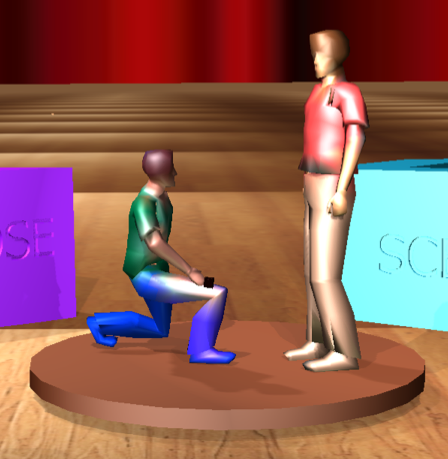
Eventually, I decided it would be best to set my scene up like a debate, to show that using the Pentad theory is helpful when analyzing people’s perspectives of cultural topics such as legalization of drugs, vegetarianism, global warming, etc. An issue with two clearly differentiating sides is gay marriage rights. I showed how the motivations of a supporter of gay rights would be obvious by the choices they make to describe a narrative involving a man proposing to another man, and the same would be true for the alternate view. 

The video I produced using the Leonar3do system as well as the LeoWorld software displays how the elements can be used to critically analyze arguments.

 
Part of the assignment for my visual
interpretation of the theory included making elements that can be printed out three-dimensionally in order to help teach the theory to others. Created using Leonar3do and LeoWorld systems, these objects help to depict the five elements as well as allow for demonstrations of the theory at work. The main item related to the theory is a pentagon “ring” that displays one of the five parts of the pentad on each of its sides. Next is a podium to represent the presence of a “speaker” or “perspective”. I then created a thought bubble in the scene and an object that identifies the speaker’s point of view. Whatever the speaker and text is discussing, should be represented as well. I imagined a narrative about a same sex couple, so they are shown as well. However, part of the activity is that students need come up with their own scenario or find a speech or text that could be described and analyzed using the pentad theory. They then can use the pentagon shape to find the elements within their chosen act, and decide whether the argument or perspective can be easily understood as a communication act. 

The functionality of my scene’s printed objects relies heavily upon facilitating the process of Pentadic Analysis. Rather than just reading a text, hearing a speech, or looking at an image, these pieces help visualize the analysis. It is actually more difficult to go about understanding the Pentad Theory this way, and by the end they should know more about it and be able to explain it better since they have worked through all the manners in which it can be described. By setting up an ambiguous representation of a speaker and using the pentagon pentad, they can identify the five elements in Burke’s theory to examine the rhetoric. This is important because it exemplifies how Burke’s theory can be utilized as a critical thinking tool. Being able to recognize the act, agent, agency, scene, and purpose behind a message allows for better decision making in order to decide whether to absorb or reject the information in a useful way. My objects are available for download in the .obj format at: 
https://drive.google.com/folderviewid=0B0fIsxtWF8N_a05TMkpRNU9JOFE&usp=sharing

I learned a couple notable things throughout this particular assignment. Using Leo to illustrate this theory really helped me understand it better than I had when I only read the summary of it. At first, I misunderstood the function of it, and after having to actually see the idea somehow in my mind and think about showing it in a way it could be easily shared with other allowed me comprehension beyond what I initially received.The one thing I was not anticipating was how long completing this entire project would actually take. Each session I had working with the Leo system lasted no shorter than three hours, and that is with little trouble-shooting, so any larger set back with the technology caused me more stress than if I had planned out my time more efficiently. So for our next comprehensive assignment, I will better prepare for that consideration.

Drew Waechter's First Comprehensive 3D Assignment


Over the past few weeks, my group members and I have been working on our first set Comprehensive 3D projects. We were tasked with creating two types of classroom aids that could be used to help explain a communication studies concept. These were an animated video and a set of 3D printed objects, and both were created using only the various 3D technologies we had available. I hope that by sharing my experiences in this project that I can demonstrate the potential of this technology in education.

Before I could start creating my various learning aids, I had to find a communication concept to visualize. To find my concept, I used an online database provided by the Society for Conceptual Logistics in Communication Research (SCLCR). It took me awhile, but I finally chose to visualize Zizi Papacharissi’s concept of “The Networked Self”. I chose this concept because I felt that it would be a fun challenge to try to convert something fairly abstract into 3D. I then spent a few days to research and make sure that I fully understood the concept. Once I felt confident enough, I then started designing my learning aids.


After finding my concept, I was then able to start creating my video. To prepare for my video, I spent a fair amount of time sketching out a blueprint of my model and a creating a storyboard for my animation. Creating this blueprint was

absolutely vital as it allowed me to thoroughly plan out my model and animation in advanced. Having this strong foundation was quite useful and it helped me to get the most out of the time that I spent in Leonar3Do. The model creating experience was quite fun and was probably my favorite part of the whole process. I enjoyed building my scene and adding the little bits and pieces together to create my vision.


After creating my model with Leonar3Do, I then used the animation features in the LeoWorld software to bring the concept to life. Honestly, I would have to say that animating was the most difficult and time-consuming part of this entire experience. In my first animation attempt, I developed a bad habit of nitpicking and over adjusting each frame of my animation. I made so many adjustments, that by the time I completed my animation it didn’t even remotely resemble my original storyboard. After seeing how confusing and jarring the animation was, I then decided to scrap the whole
thing and start fresh. My second attempt in animating was a much more successful. I forced myself to strictly follow the storyboard I had created. This not only kept me calm and focused, but it prevented me from wasting precious time. I then allowed myself a day away from the computer and returned the following day to edit with a fresh mind. This greatly increased my productivity and within a few hours I was able to finally finish my animation. With my animation complete, I then added narration and edited the footage in video editing software to create an educational video of my concept.

The second half of this project was to create tangible objects from my scene that I felt would be useful in a classroom setting. These objects would need to be able to be shared with the general public and easily printable with a 3D printer. The objects I chose were my humanoid token and a speech bubble. My idea was that students would be able to use these object to create and map out their own networked selves in a classroom. This would allow students a chance to visualize the concept and give them opportunity to apply what they’ve learned.


I also chose these two objects because I felt that they could be used to help visualize other communication concepts. I think it would be interesting to create a set of universal objects in which an instructor could pull out at any time. That way they could have a kit of sorts to demonstrate various communication concepts and theories. With that in mind, I created my objects to be simple enough that anyone could take them and customize them for their own use.

After completing this project, I feel that 3D technology is a powerful tool in the classroom. Whether it is creating a 3D video or model or using tangible 3D objects, I feel that 3D provides rich a learning experience for students. From my own personal experience with this project, I feel that I’ve been challenged to think and perform in a way that feels far more rewarding than simply listening to a lecture. I feel like I’ve been given the opportunity to use my creativity and critical thinking skills to fully immerse myself into a communication studies concept.
 I’m excited to see how this technology will change  education in the years to come.

 If you would like to use any of the objects created in this project feel free to click here for all of the items our group has created so far.

Thursday, March 20, 2014

Preparing My G.I.F.T For CSCA


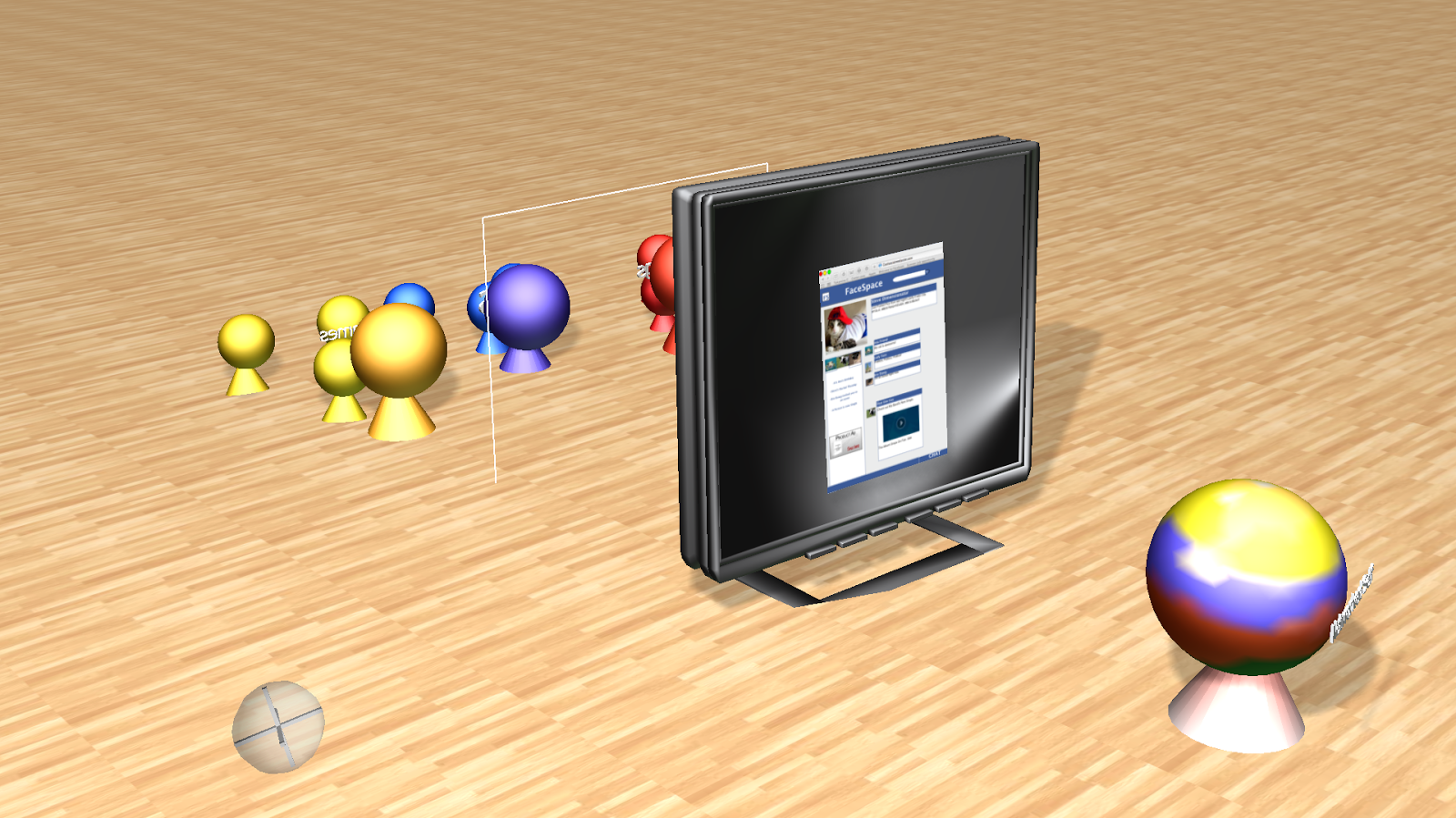
In preparation for this conference I have been busy over this last creating my second concept model in Leonar3Do. For this model I chose to create a model of Zizi Papacharissi’s concept of networked self. If you’d like to read more about this concept, then feel read to the following article here.

 I’ve made a lot of progress on my model during this last week. On Tuesday I was able to create my primitive shapes and figurines with Leonar3Do Today I then started messing around with the layout of my model. Currently, I’m in a bit of a standstill with my model. I’m trying to find some pre made OBJ objects to incorporate into my scene. I’ve been looking on various sites, but there are so many different options that I just need to decide what type of object I want to use. Once I deicide on an OBJ, I will then be able to start animating my scene. My goal is to start animating by this weekend so that I will be able to have enough time to edit together a short video of my concept.

The more I’ve worked with the Leonar3Do the more I’m starting to enjoy it. With each passing week it becomes less intimidating and much more exciting to use. I’ve found myself experimenting more with the software, and trying out different ideas as I’m building my scene. I’m still having a few issues with the software, but I’m at the point in which I feel that I can watch a tutorial video and work my way through any problem. 

I’m excited to see how this project will turn out. I’ve put a lot of effort into the creation of this second model and I hope that it will be intriguing to those at the conference.

Marcella's Work on her Comprehensive 3D Project

I am working on my first comprehensive 3D project, and I have decided to conceptualize the agenda setter theory. So far I have begun work on my scene. I created the agenda setter and have put a tunnel through its head so that I can drop the ideas through to the tunnel. The tunnel will be created using a sphere and five or six cylinders. The objects representing society will be represented by OBJ files. I have begun searching for free OBJs and ran into a problem when I imported one. It had a large disk around the bottom of it that I could not delete. I will have to search for different one and see if I can get rid of that problem.

The rest of my process will include completing my scene, creating an animation and making a video to narrate the concept. I will then present my concept and project to a group of communication studies professors and my peers.

This project is making me excited for the Central States Communication Association’s Conference because I know I will have something to be proud of to show to the attendants.